Thursday, July 21, 2011

ευχαριστώ, Ελλάδα

After two weeks in the paradise more commonly known as Greece, I am back in Copenhagen, experiencing the highly expected traditional post-vacation-downer. It was a holiday filled with all the ingredients I love: new places and faces, indescribably delicious food (and a lot of it!), a beautiful foreign language, hours of relaxation, breathtaking landscapes and historical sights, summer heat and sunshine, and the best company possible. It was a perfect mixture of downtime and adventure, and not only was I able to escape reality for a couple of weeks, but I achieved my first veritable tan, learned a new alphabet, and managed to pick up 89 words (tallied during the return flight takeoff, to calm my flying nerves) in a stunning language. I would give anything to have stayed in that bubble of bliss for just a bit longer, but I suppose that is what makes holiday travels so special. It's like when you are younger, and all you want is Christmas every day--it sounds like a fantastic idea. But as you get older, you realize that Christmas is so wonderful because it only comes once a year, because it isn't just an every day thing. For me, Greece shall be the same; it is a Christmas-level sort of place, and I would not have it any other way. Until next time, then, a big fat Greek thank you (or "ευχαριστώ") to everybody there who made my holiday so unbelievably fantastic.


Street meat, highway-style. On the way to the house after landing in Thessaloniki, we stopped at this kiosk on the side of the highway. People pull over, hop the barrier, pick up some sodas, and keep on truckin'.


A slice of heaven.


While having a φραπές--or, a delicious Greek iced coffee--we saw this magnificent sunset over Mt. Olympus. I'd normally call it "Jesus light," but in this instance, I think "Zeus light" might be more appropriate.


Monkeying around at the Archaeological Museum in Dion.


One of my favorite villages we visited, Paleo ("Old") Panteleimonas. Like taking a step back in time, it was an escape from the escape from reality. Amazing.


1100m up Mt. Olympus. I got a bit light-headed, but a lunch of φασολάδα--fasolada, Greek's delicious national dish--and panoramic views like this one definitely helped.


At Aphrodite's Spring, down the end of this narrow tunnel was a font, out of which poured the clearest, freshest water you'll ever taste. The tight squeeze was worth the reward.


In Athens for the evening, I had to go to the Acropolis. I have no words, except: if you can, you must see this.


Athens, down the rabbit hole...


A trip to the islands, first stop: Thira, aka Santorini. This is the town of Oia by night. Fantastic!


And by morning, the view of Santorini's biggest village, Fira, from the old village of Firostefani.


No, this is not a pool. This is what the water really looks like.


The biggest--but smallest!--slice of paradise of all: Κουφονήσια.


This small island is my new favorite place on Earth. If ever I'm instructed to "go to my happy place," this is where I'll be.

This is just a small taste of my big fat Greek holiday. I cannot say enough how warm the people are, how beautiful the country is, and how delicious the food tastes. If you're ever searching for a perfect combination of relaxation and new adventures, consider Greece. You won't regret it--you'll only regret ever having to come home.

Friday, July 1, 2011

jetlag

After five weeks away, it is really nice to be home for a week before I take a little trip to another land. Having lived in Copenhagen for over two years now, I can say that while I love this city (or at the very least, really like the whole city and love Vesterbro), it can get claustrophobic at times. Copenhagen is what I call a "little big city." And that's literally what it sounds like: while technically dubbed a city, as a New Yorker I can say with confidence that it is a very small city. To be sure, this is part of its charm, but it can also make me go a bit bonkers after a while. There are only so many times you can bike around the same neighborhoods or sit in the park before it gets a bit monotonous, no matter how lovely the weather might be.

And so it is wonderful to come back to sunny skies and warm weather, and to be able to re-appreciate this little big city I have come to call home. Despite the fact that the entire city seems to be under construction at the moment (see my lovely friend Sandra's blog for more on this!), Copenhagen really is quite fantastic in the summer. Before I go on vacation in a week, I plan to take full advantage of being able to do nothing and anything--and of the summer sales going on right now. So, a little photographic ode to good ol' CPH, as I continue the battle against jetlag...


New street art on Westend, my favorite block in Copenhagen.


"Blomster om sommeren" -- flowers in summer.


I love Vesterbro...

Wednesday, June 29, 2011

savage beauty

After our final performance in New York, our summer holidays began. I kicked mine off by staying an extra week at home on Long Island, enjoying some quality crazy time with my family and boyfriend. Suburban downtime was mixed with a healthy dose of playing New York City tourist: walking around downtown Manhattan, exploring the beautiful new High Line park, eating really excellent food, etc. etc. Aside from generally soaking up New York City, there was one specific thing I had on my agenda: the Alexander McQueen exhibit at the Metropolitan Museum of Art.

As someone who regularly steps outside her apartment looking like a homeless person (due mostly, I have come to think, to my schizophrenic head of hair), I may not seem like the fashion exhibition type. However, beneath the black-goes-with-black, this-smells-clean ensemble lies someone who is, in fact, a big fan of fashion. When I was 18 and living in Miami, I used to go down to this fantastic small boutique on Lincoln Road to shell out $15 for French Vogue. I could understand maybe three words in every issue, but I would read it like some sort of Bible. And here in Denmark, I will often sacrifice good kroner at Magasin for American Vogue--justifying this purchase as a "slice of home" that I can fully understand. My lack of daily style is not indicative at all of my love for fashion. My mentality is such: had I the funds to purchase the wardrobe I desire, I would readily do so. Since I do not currently possess such gold, and wish to remain out of 'minus,' I make do with the closet full of so-so clothes that I have. And when I do occasionally have money to burn, I carefully select one hopefully timeless item on which to splurge.

When I read that Alexander McQueen was the subject of a fashion exhibit at the Met, I was thrilled. From my years of devouring Vogue, I had picked him as one of my dream, fairytale life designers. To me, McQueen's collections seemed more like wearable, almost painfully beautiful art--more so than almost any other designer's. The descriptions of his runway shows made me love him even more; his runway presentations told stories, bringing drama and emotion to the fantastical garments he created. And beneath the masterful execution and magical quality of his collections was always a sense of beautiful darkness, a hint of "savage beauty," as it were.

According to those who knew him, McQueen was a deeply troubled but optimistic person, one with a great knowledge and respect for history, and with an immeasurable imagination. The Met exhibition, stunningly arranged and beautifully comprehensive, shows that with McQueen's tragic death in February of last year, the world lost a true visionary artist. I can honestly say that this exhibit was one of my favorite museum experiences of my life, and I can only wish that I could see it just once more.


Dress, ivory silk organza, Widows of Culloden (autumn/winter 2006-7).


Coat of duck feathers painted gold, autumn/winter 2010-11.


Dress, white cotton spray-painted black and yellow with underskirt of white silk, No. 13 (spring/summer 1999).


"Oyster" dress, ivory silk, Irere (spring/summer 2003).


Dress, black duck feathers, The Horn of Plenty (autumn/winter 2009-10).


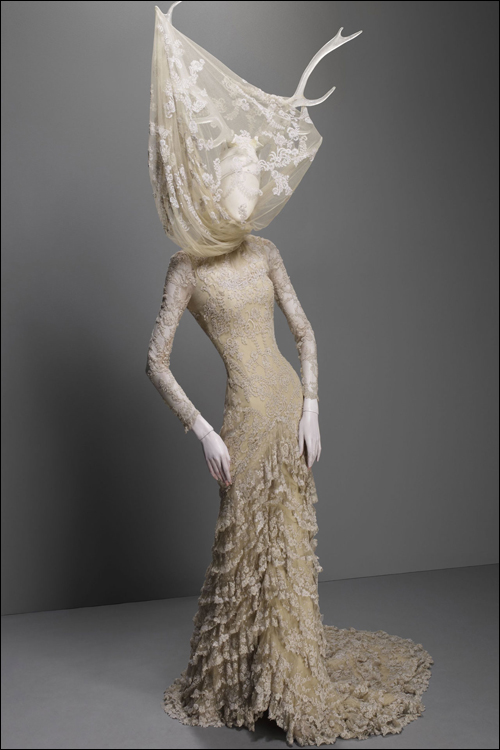
Dress, cream silk and lace with resin antlers, Widows of Culloden (autumn/winter 2006-7).


Images from the Alexander McQueen: Savage Beauty exhibition at the Metropolitan Museum of Art.

"I find beauty in the grotesque, like most artists. I have to force people to look at things." ~ Alexander McQueen (1969-2010)

summer, summer, summertime...

As the great lyricist Will Smith once wrote, it is now officially "summer, summer, summertime, time to sit back and unwind." After a month-long tour to the good ol' United States of America (and a month-long hiatus from this blog of mine), I am back in Vikingland for a proper Scandinavian sommerferie.

But first, some highlights of RDB's big 2011 tour across America. Following a 17-hour travel day, which closely resembled an inner circle of hell, we started off with a week in Orange County. A week in Berkeley came next; then a week in the motherland's great capitol city of Washington, DC; and finally, a grand finale on my home turf: New York, the city so nice they named it twice. It was a long tour, it was a hard tour, but it was a fantastic, fun way to end a difficult, ultimately very gratifying season. And after having spent an unbelievably hilarious, relaxing, perfect week at home on Long Island with my family following the tour's end, I am now back in Copenhagen to continue enjoying the summer holiday. My jet lag--combined with the wonderfully long Scandinavian sunlight hours of summer--means I'm nearly cross-eyed at this time, but until I get back on European time, some photos from America, to get back in the swing of this blog...


A lovely community garden in San Francisco.


Monkeying around on tour...


It was fantastic to visit San Francisco again, after six years or so.


My first time in DC--heaven for this Bones fan. Agent Booth works here! ;-)


I felt this was only an appropriate pose, considering the circumstances. And considering I'd already made enough bad political puns that morning.


Inspired by the street art near PS1 MoMA.


Situations like this one are why I love love love downtown New York.

Monday, April 25, 2011

Long Live the (Mc)Queen

I am not a fashionista, by any stretch of the imagination: I have been known to wear pajama pants on grocery store runs, and also I own a Snuggie. In my weak defense, my lack of creativity with my daily ensembles mostly stems from the fact that I rarely wear an outfit for longer than my 15-minute bike ride to and from the theatre (and also, the cost of my dream wardrobe far exceeds my anemic funds). But despite my "black-goes-with-everything" amount of effort that I put into my personal everyday look, I do have a typically girlish love and appreciation for fashion, and one of my favorite designers is the late, great Alexander McQueen, whose garments never lack for imagination or drama.

The current creative director of Alexander McQueen, one Sarah Burton, spoke with Vogue recently about several of McQueen's dresses, which are set to be part of the Costume Institute's upcoming exhibition "Alexander McQueen: Savage Beauty," opening May 4 at the Met in New York City. Turns out that the stories behind McQueen's designs are as inspired and as dramatic as they look.

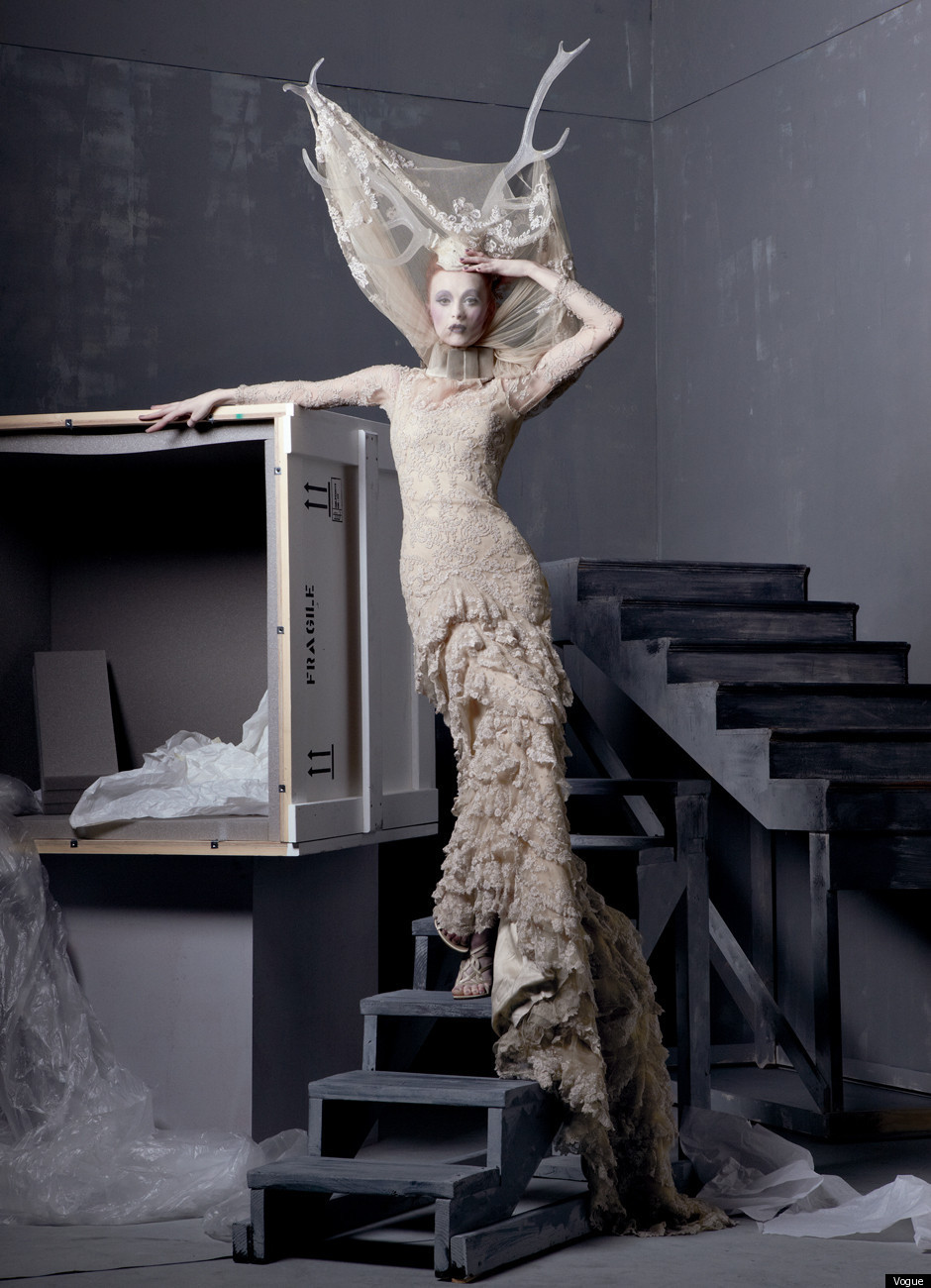
The dress below is from the Fall 2006 collection, called "Widows of Culloden." Burton tells Vogue: "The collection was about the 1745 massacre of the Scottish Jacobites by the English, which Lee felt so passionately about because of his Scottish family heritage, which his mother had researched. The women were the widows of the slaughtered army. This dress was actually based on my wedding dress--I got married two years earlier. We had to figure out how to make lace work in the round with those ruffles because Lee hated gathering. So we cut out all of the flowers from the lace and reappliquéd it on tulle to make our own fabric. This is the collection most people remember as the one with Kate Moss in a hologram. Oh, my God, it was so beautiful. He loved that show."


And of this dress, from the "Voss" Spring 2001 collection, Burton recalls: "So much of this show was about the collective madness of the world. It was presented in a two-way mirrored glass box in London, and the girls had bandaged heads, acting like inmates of a mental asylum. Lee wanted the top of this dress to be made from surgical slides used for hospital specimens, which we found in a medical-supply shop on Wigmore Street. Then we hand-painted them red, drilled holes in each one, and sewed them on so they looked like paillettes. We hand-painted white ostrich feathers and dip-dyed each one to layer in the skirt."


Alexander McQueen's designs are beautiful not only for their masterful execution and obvious uniqueness, but because his pieces evoke strong reactions and emotions, and convey a sense of importance and story (if not exactly the tale which inspired the designer). His clothes are art and theatre unto themselves, and for this somewhat self-apathetic fashion lover, worthy of worship, indeed.

Sunday, April 17, 2011

the most beautiful equation

Etudes is an exercise in beauty; to me, its brilliance lies in its choreographic elegance and almost mathematical playfulness of the musicality. The strict counts and clean lines give this ballet a stunning, unexpected quality--in a way, Etudes is the most beautiful science put to music. This got me wondering: is there such a thing as "beautiful" math or science? And my research led me to what many scholars agree is the "most beautiful theorem in mathematics": Euler's Identity.

Named for Swiss-German mathematician Leonhard Euler, Euler's Identity is the equality in analytical mathematics:


where e is the base of natural algorithms (Euler's number); i is the imaginary unit--i² = −1; π is pi.

The reason Euler's identity is considered remarkable is because of its mathematical beauty. The three basic arithmetic operations occur exactly once each: addition, multiplication, and exponentiation. The equality also connects five fundamental mathematical constants:

- The number 0, or the additive identity
- The number 1, or the multiplicative identity
- The number π, ever-present in trigonometry, the geometry of Euclidean space, and analytical mathematics
- The number e, which is the base of natural logarithms
- The number i, or the imaginary unit of the complex numbers

Euler's Identity is a special case of Euler's formula from complex analysis, which reads (for any real number x):


And notably,


since cos π = -1 and sin π =0, then it must be true that


This gives us Euler's Identity:


The simplistic elegance of this equation, in mathematical beauty standards, is stunning; many scholars have waxed poetic about this one equality. A poll of readers conducted by The Mathematical Intelligencer magazine named Euler's Identity as the "most beautiful theorem in mathematics"; in another poll of readers by Physics World magazine Euler's Identity tied with Maxwell equations (of electromagnetism) as the "greatest equation ever". There is an entire 400-page mathematics book written by Dr. Paul Nahin devoted to the identity: Dr. Euler's Fabulous Formula; the tome professes that Euler's Identity sets "the gold standard for mathematical beauty." After proving Euler's Identity during a lecture, Benjamin Peirce, the noted American philosopher/mathematician and a professor at Harvard University, said, "It is absolutely paradoxical; we cannot understand it, and we don't know what it means, but we have proved it, and therefore we know it must be the truth." Perhaps Stanford University mathematics professor Dr. Keith Devlin was most poetic: "Like a Shakespearean sonnet that captures the very essence of love, or a painting that brings out the beauty of the human form that is far more than just skin deep, Euler's Equation reaches down into the very depths of existence."

Etudes has the same sort of clean beauty and technical impressiveness as Euler's Identity, albeit in a completely different way. Etudes takes the precise structure of the ballet class and emphasizes the beauty behind pure technique, much as this equality stresses the importance and beauty of the most basic numbers and functions in mathematics.

Tuesday, April 12, 2011

inception, personified

Visual artist Maria Fischer has created a beautiful literary representation with her book Traumgedanken, or "dream thoughts." The text is a collection of literary, philosophical, psychological, and scientific passages that provide different insights into various dream theories. But what makes this book particularly unique, and a dreamlike work of art unto itself, is its design.

The book is designed as a physical model of a dream about dreaming. The slices of reality used to assemble a story bring the different text excerpts together. They are connected by actual threads which tie into certain key words--with the threads personifying the fragile, confused nature of dreams. Five of the pages contain illustrations made out of thread, with their form and color relying on key words on the opposite page. In this manner, Fischer has stunningly created for the reader an abstract image of a dream about dreaming. Moreover, there are five pages where a large excerpt from a text of the opposing page is stitched into the paper, thus rendering the text illegible since the type’s actual surface is inside the folded page. Fischer uses this to express the enigmatic characteristics of dreams, as well as the idea of dream interpretation.

Fischer has, in my opinion, created something wonderful. She has managed to (literally) weave together art and science, and has wisely chosen a more "creative" science as her topic--that grey area of dreamland. I hope to one day get my hands on a copy, if only to see for myself what it is like to untangle the threads and discover dreaming...